
 EN
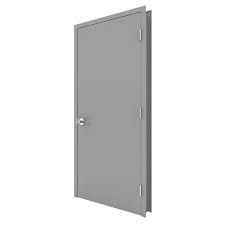
A steel door with a polyurethane core is often sold as a two-for-one: forced-entry resistance on one side, thermal performance on the other. The marketing is not wrong, but it flattens an important distinction. Security and insulation are delivered by different parts of the same assembly, and they fail for different reasons. The steel skins, the edge channels, and the locking hardware carry the security load. The foam core carries the thermal load. A door can be excellent at one and mediocre at the other if the build is unbalanced, and the specification has to treat them as separate performance tracks that happen to share a leaf.
That separation matters on site because the two properties are tested and rated by different standards. Forced-entry resistance runs through EN 1627, which assigns resistance classes based on the tools and time an attacker needs to get through. Thermal performance runs through U-value calculations that treat the door as part of the building envelope, with the frame, seals, and threshold included. A door that passes RC3 and a door that hits a low U-value are solving different problems. The polyurethane core is where the thermal story lives. The security story lives in the steel and the hardware.
The Steel, Not the Foam, Decides How Long an Attack Lasts
The first thing to get straight is that polyurethane foam is not a security material. It is rigid and it fills the cavity, which helps the leaf resist local deformation, but an attacker with a crowbar is not defeated by foam density. The resistance comes from the gauge of the steel skins, the continuity of the edge construction, and the number and placement of locking points. A door built with thin skins and a single-point lock is not made secure by pouring in a denser core.
EN 1627 RC2 sets a resistance time of three minutes against basic tools like screwdrivers, pliers, and wedges. RC3 extends that to five minutes and adds heavier hand tools such as a crowbar or a manual drill. The test is not a measure of how much force the door can absorb in one hit. It is a measure of how long the leaf, frame, and hardware can keep an attacker from creating an opening. That time is bought by steel thickness, hinge reinforcement, and multi-point locking that ties the leaf to the frame along the full perimeter. A 16-gauge hinge channel welded full height, for example, keeps the hinge side from peeling open when the leaf is pried. The foam sits behind that structure and contributes stiffness, but it is not the line of defense.
Why Closed-Cell Polyurethane Wins the Thermal Argument
The thermal case for polyurethane is easier to state and harder to argue with. The thermal conductivity of polyurethane foam sits around 0.019 W/m·K in published comparisons, while a cardboard honeycomb core used in a commercial steel door runs closer to 0.16 W/m·K. That gap is roughly eightfold, and it is the reason a polyurethane core can deliver meaningful R-value in a door leaf that is only 1-3/4 inches thick. Closed-cell foam also resists moisture uptake, which matters because a door is a wet assembly in service. Rain, condensation, and washdown water all find their way to the edges eventually, and an open-cell or fibrous core that holds water loses thermal performance and adds weight to the hardware.
The thermal performance is not just about the core material. It is about how completely that material fills the cavity and how well it bonds to the skins. Foam-in-place polyurethane expands to fill the leaf and adheres to the steel, which eliminates the air pockets and internal convection loops that form when board stock is cut and inserted. That full contact is what turns the door into a composite action panel rather than a steel box with insulation rattling inside. It also stiffens the leaf, which helps the door hold its shape through thermal cycling and repeated slamming.
The Bond Line Is the Quiet Weak Link
A polyurethane core door is a sandwich, and every sandwich depends on the adhesive layer between skin and core. The faces can be the right gauge and the foam can be the right density, but if the bond line delaminates under thermal cycling or moisture, the door loses both stiffness and thermal continuity. Polyurethane adhesive is the usual choice for this joint because a cured PU bond line stays elastic, absorbing the differential expansion between steel and foam as the door moves through temperature swings. A rigid adhesive can micro-crack at the interface and start a delamination that spreads invisibly until the skin sounds hollow when tapped.
This is not a theoretical concern in exterior doors. A west-facing steel door in a cold climate can see its exterior skin drop far below the interior skin temperature, and the two materials want to move at different rates. A bond line that can flex without losing adhesion keeps the composite intact. A bond line that has gone brittle turns the door into two independent skins with a loose core between them, and the thermal performance drops before the security performance does. Peel strength at the panel edges is the most sensitive predictor of this failure, which is why edge bonding quality matters as much as face bonding quality.
Reading the Whole Assembly, Not the Core Label
The R-value printed on a foam data sheet is not the R-value of the door. The whole assembly includes the frame, the threshold, the seals, and the thermal bridges at the hinges and lock. A polyurethane core with a thermally broken frame can push the whole-door U-value below 0.8 W/m²·K in high-performance builds, while a basic insulated panel without a thermal break may sit around 1.5 W/m²·K. The difference is not the foam. It is whether the heat has a path around the foam.
| Door build | Core | Frame / edge treatment | Whole-assembly U-value | Where the thermal weakness sits |
|---|---|---|---|---|
| Basic insulated steel door | Polyurethane, foamed in place | Standard steel frame, no thermal break | Around 1.5 W/m²·K | Conducted heat at frame and threshold |
| High-performance insulated door | Polyurethane, foamed in place | Thermally broken frame, sealed perimeter | Below 0.8 W/m²·K | Residual conduction at hardware penetrations |
| Door with board-stock insulation | Cut foam board, air gaps at edges | Standard frame | Poorer than foamed core at equal thickness | Convection in gaps and at unsealed edges |
The third row is the one that catches value-engineered projects. A door that uses cut foam board instead of foamed-in-place polyurethane can have the same nominal core thickness and a visibly different U-value, because the gaps around the board allow air movement and break the continuity of the insulation. The foam chemistry is the same. The manufacturing process is not.
Condensation Is the Thermal Failure People Actually See
A low U-value is an energy metric. Condensation is the visible consequence. When the interior surface of a steel door drops below the dew point of the indoor air, moisture forms on the door face, and in cold climates it freezes. The surface temperature is controlled by how well the assembly keeps the cold exterior skin from pulling heat out of the interior skin. A polyurethane core with good bond continuity and a thermal break at the frame keeps the interior surface closer to room temperature, which keeps it above the dew point in most occupied-space conditions.
This is where the security and thermal stories intersect in a practical way. The steel skins that carry the security load are also the surfaces that conduct heat. If the frame is a straight steel path from outside to inside, the interior skin at the perimeter will run cold no matter how good the core is, and condensation will start at the edges first. A door that meets an RC rating but skips the thermal break can still drip onto the floor in winter. The core solves the center-of-leaf problem. The frame detail solves the perimeter problem.
A Cold-Climate Retrofit Where the Frame Detail Decided the Result
An instructive case comes from a distribution facility in a northern climate where an exterior steel personnel door was replaced after repeated winter complaints. The original door had a polyurethane core and met its security requirement, but the interior face showed a condensation line along the hinge side and the threshold every morning. The hardware was not failing, and the core was intact. The frame was a continuous steel section with no thermal break, and the interior skin at the perimeter was running close to the exterior temperature.
The replacement kept the same security class but paired a foamed-in-place polyurethane core with a thermally broken frame and a sealed threshold. The interior surface temperature at the hinge side rose enough to stay above the dew point through the coldest week of the year, and the condensation line disappeared. The security performance did not change because the steel gauge and locking configuration stayed the same. The thermal performance changed because the heat path around the foam was interrupted. That is the distinction that gets lost when a door is specified by core material alone.
What Consistent Manufacturing Brings to a Two-Property Door
A steel door that has to deliver both security and insulation depends on tolerances that are set during fabrication: skin gauge uniformity, edge channel weld continuity, foam fill completeness, and bond line coverage across the full leaf. A leaf that is foamed in place with incomplete fill has a thermal void even if the security structure is sound. An edge channel that is skip-welded to save time can create a local weak point that shows up in an RC test as a faster opening. These are not installation variables. They are built into the door before it ships.
Glostar Panel’s steel door production covers foamed-in-place polyurethane cores with controlled fill and bond coverage, and the security-side construction uses the edge reinforcement and locking preparation that the resistance class requires. The limitation is that a well-built door still depends on a frame and threshold that match its thermal intent. A polyurethane core behind a steel frame without a thermal break is a half-solution, and no amount of core quality fixes the perimeter. Manufacturing consistency holds the door to its ratings. It does not choose the frame detail that makes those ratings useful in service.
Table of Contents
- The Steel, Not the Foam, Decides How Long an Attack Lasts
- Why Closed-Cell Polyurethane Wins the Thermal Argument
- The Bond Line Is the Quiet Weak Link
- Reading the Whole Assembly, Not the Core Label
- Condensation Is the Thermal Failure People Actually See
- A Cold-Climate Retrofit Where the Frame Detail Decided the Result
- What Consistent Manufacturing Brings to a Two-Property Door