
 EN
EN
When Conventional Construction Fails in Sub-Zero Conditions
Prefabricated houses face a unique challenge in extreme cold climates: the same lightweight construction that makes them quick to assemble also makes them vulnerable to heat loss. Traditional stick-built homes rely on mass and thermal inertia—thick walls, dense materials, slow temperature swings. A prefab structure, by contrast, has less mass to buffer against temperature extremes. Get the insulation wrong, and the building becomes uninhabitable or ruinously expensive to heat.
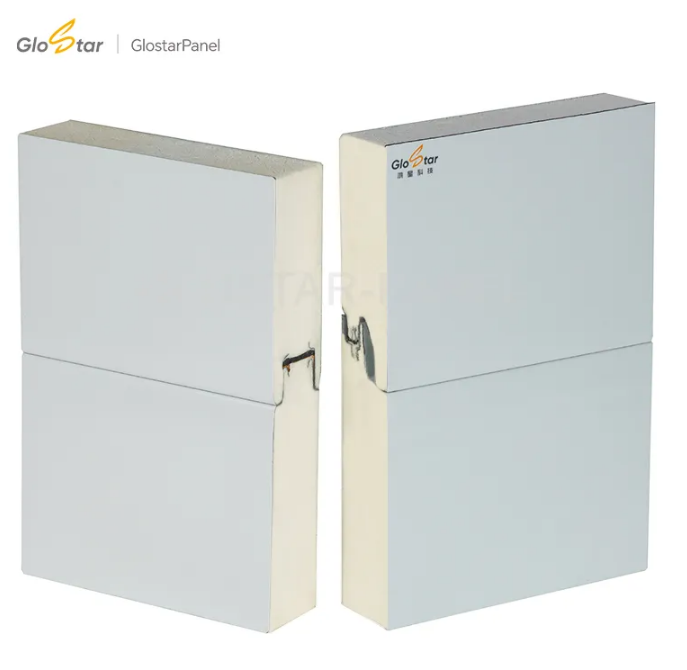
Sandwich panels have emerged as the go-to solution for this exact problem. Their core principle—a layer of high-performance insulation sandwiched between two structural facings—delivers thermal performance that outperforms conventional cavity insulation by a significant margin. But not all sandwich panels are created equal, and extreme cold exposes the weaknesses of marginal products quickly.
Understanding the Thermal Physics at Play
Heat transfer through building envelopes happens through three mechanisms: conduction, convection, and radiation. In extreme cold, conduction becomes the dominant concern. The temperature differential between interior and exterior can exceed 60°C (140°F) in places like northern Canada or Siberia. Every point of thermal bridging—where the insulation layer is compromised—becomes a highway for heat to escape.
The key metric for sandwich panel performance is thermal conductivity, expressed as lambda (λ) in W/m·K. Lower numbers mean better insulation. For reference:
Traditional mineral wool insulation: λ ≈ 0.038–0.045 W/m·K
EPS (expanded polystyrene): λ ≈ 0.030–0.038 W/m·K
XPS (extruded polystyrene): λ ≈ 0.028–0.033 W/m·K
PIR (polyisocyanurate): λ ≈ 0.022 W/m·K
That difference isn't academic. A 100mm polyurethane panel delivers roughly the same thermal resistance as 150mm of mineral wool. For a prefabricated house, where wall thickness is often constrained by transport and assembly logistics, that efficiency advantage translates directly into either a thinner wall for the same performance or better performance for the same thickness.
The Joint Problem That Makes or Breaks Performance
Panel insulation values are specified in controlled laboratory conditions. Real-world performance depends heavily on how panels connect to each other. In extreme cold, thermal bridging through joints can reduce overall envelope performance by 20 to 40 percent.
The industry has developed several joint configurations to address this. The simplest is the flat joint with a sealant bead—effective but vulnerable to differential movement as temperatures fluctuate. The more robust approach uses tongue-and-groove profiles with interlocking geometry that creates a labyrinth seal.
Double tongue-and-groove designs, where two interlocking ridges engage on each panel edge, offer superior performance. The air pockets within the joint geometry act as additional thermal breaks. PU foam filling at the joint further eliminates voids where convection could occur.
| Panel Joint Type | Thermal Bridging Effect | Suitability for Extreme Cold (< -30°C) |
|---|---|---|
| Flat joint with sealant | High (20–30% loss) | Not recommended |
| Single tongue-and-groove | Moderate (10–20% loss) | Marginal |
| Double tongue-and-groove with foam fill | Low (5–10% loss) | Recommended |
| Double tongue-and-groove with edge-sealed PU | Minimal (<5% loss) | Preferred |
Field data from Arctic construction projects shows that properly jointed sandwich panel envelopes achieve U-values within 10 percent of laboratory ratings, while poorly jointed assemblies can underperform by 30 percent or more.
A Northern Quebec Project That Put Theory to the Test
A modular housing project in northern Quebec, completed in 2021, provides a useful case study. The development consisted of twenty-four prefabricated units for a remote mining camp, where winter temperatures regularly drop below -40°C. The original specification called for 150mm mineral wool cavity insulation with a conventional wood frame—a standard approach in milder climates.
The engineering team ran the numbers and found the design would require heating loads exceeding 150 W/m² to maintain indoor temperatures at 21°C. At diesel heating costs in remote locations—often exceeding $2.00 per liter delivered—the annual heating bill per unit would approach $12,000.
The redesign switched to 120mm PIR-core sandwich panels with double tongue-and-groove joints and PU edge sealing. The calculated heating load dropped to 65 W/m². The thinner wall also increased interior floor area by approximately 5 percent per unit—a meaningful gain in compact living spaces.
Two winters of operational data confirmed the calculations. Indoor temperatures remained stable within ±1°C despite exterior swings from -5°C to -42°C. Heating fuel consumption came in 58 percent below the original design estimates. The upfront premium for the sandwich panel system—about 18 percent higher than the wood-frame alternative—was recovered in less than two heating seasons.
Layering Strategy: When One Panel Type Isn't Enough
Extreme cold applications sometimes benefit from a hybrid approach. The exterior skin of a sandwich panel drops to near-ambient temperature in winter. If that skin is metal—which it typically is—the cold conducts through the facing and creates a temperature gradient across the core.
For the most demanding climates, a two-layer system can outperform a single thicker panel. The outer layer provides weather protection and a first stage of thermal resistance, while the inner layer delivers the bulk of the insulation. An air gap between layers, if properly vented, can add additional resistance through radiative barriers.
This approach is more common in commercial cold storage than in residential prefab, but the principle applies. A facility in northern Sweden used a 100mm PU panel for the primary envelope with an additional 50mm rock wool panel as an interior thermal break. The rock wool's lower density and higher vapor permeability allowed moisture to migrate outward, preventing condensation within the wall assembly—a critical consideration when interior humidity meets exterior cold.
The Moisture Management That Nobody Talks About
Thermal performance gets all the attention, but moisture management is equally critical in extreme cold. The temperature gradient across the wall creates a vapor pressure differential that drives moisture from the warm interior toward the cold exterior. If that moisture condenses within the panel core, insulation performance degrades, and structural components can rot or corrode.
Sandwich panels with closed-cell foam cores—PU and PIR—are inherently vapor-resistant. The closed-cell structure prevents moisture migration through the core itself. The vulnerable points are the joints and edges. Proper edge sealing, using PU foam or specialized sealants, creates a continuous vapor barrier that prevents interior humidity from reaching the cold exterior skin.
Rock wool and glass wool cores, by contrast, are vapor-permeable. They require careful attention to the vapor barrier placement—typically on the warm side of the assembly—to prevent condensation within the core. For extreme cold applications where the temperature differential is large, the margin for error on vapor control is slim.
| Core Material | Vapor Resistance | Risk of Condensation in Extreme Cold | Recommended Application |
|---|---|---|---|
| Polyurethane (PU) | High (closed cell) | Low | Preferred for extreme cold |
| PIR | High (closed cell) | Low | Preferred for extreme cold |
| Rock wool | Low (open structure) | Moderate–High | Requires dedicated vapor barrier |
| EPS | Moderate | Moderate | Marginal below -30°C |
Installation Details That Separate Success from Failure
The best panels in the world perform poorly if installed incorrectly. In extreme cold, installation errors become magnified because thermal expansion and contraction are more severe. A panel joint that fits perfectly at 20°C may gap or bind at -40°C.
Key installation practices for cold-climate prefab:
Acclimatization. Panels should be stored and allowed to reach thermal equilibrium before installation. Installing cold panels and expecting them to expand into place as temperatures rise is a recipe for gaps.
Fastener selection. Self-tapping screws with corrosion-resistant coatings are essential. In extreme cold, standard fasteners become brittle and can shear under load. Stainless steel or specialized cold-weather fasteners are worth the premium.
Sealant application. Standard silicone sealants lose elasticity below -20°C and can crack. Cold-weather formulations with silicone or polyurethane bases maintain flexibility down to -50°C.
Compression gasketing. Pre-compressed foam tapes that expand after installation can accommodate joint movement better than liquid-applied sealants in severe temperature swings.
For prefabricated houses destined for extreme environments, these details are non-negotiable. Skipping them to save a few dollars per panel typically costs many times that in remedial work or elevated heating bills.
Manufacturers that specialize in cold-climate applications, such as Glostar, produce sandwich panels with precisely controlled core densities and edge-sealing systems that address these challenges. The combination of low thermal conductivity, robust joint geometry, and vapor-tight edge sealing provides the thermal envelope that extreme cold demands.
Table of Contents
- When Conventional Construction Fails in Sub-Zero Conditions
- Understanding the Thermal Physics at Play
- The Joint Problem That Makes or Breaks Performance
- A Northern Quebec Project That Put Theory to the Test
- Layering Strategy: When One Panel Type Isn't Enough
- The Moisture Management That Nobody Talks About
- Installation Details That Separate Success from Failure