
 EN
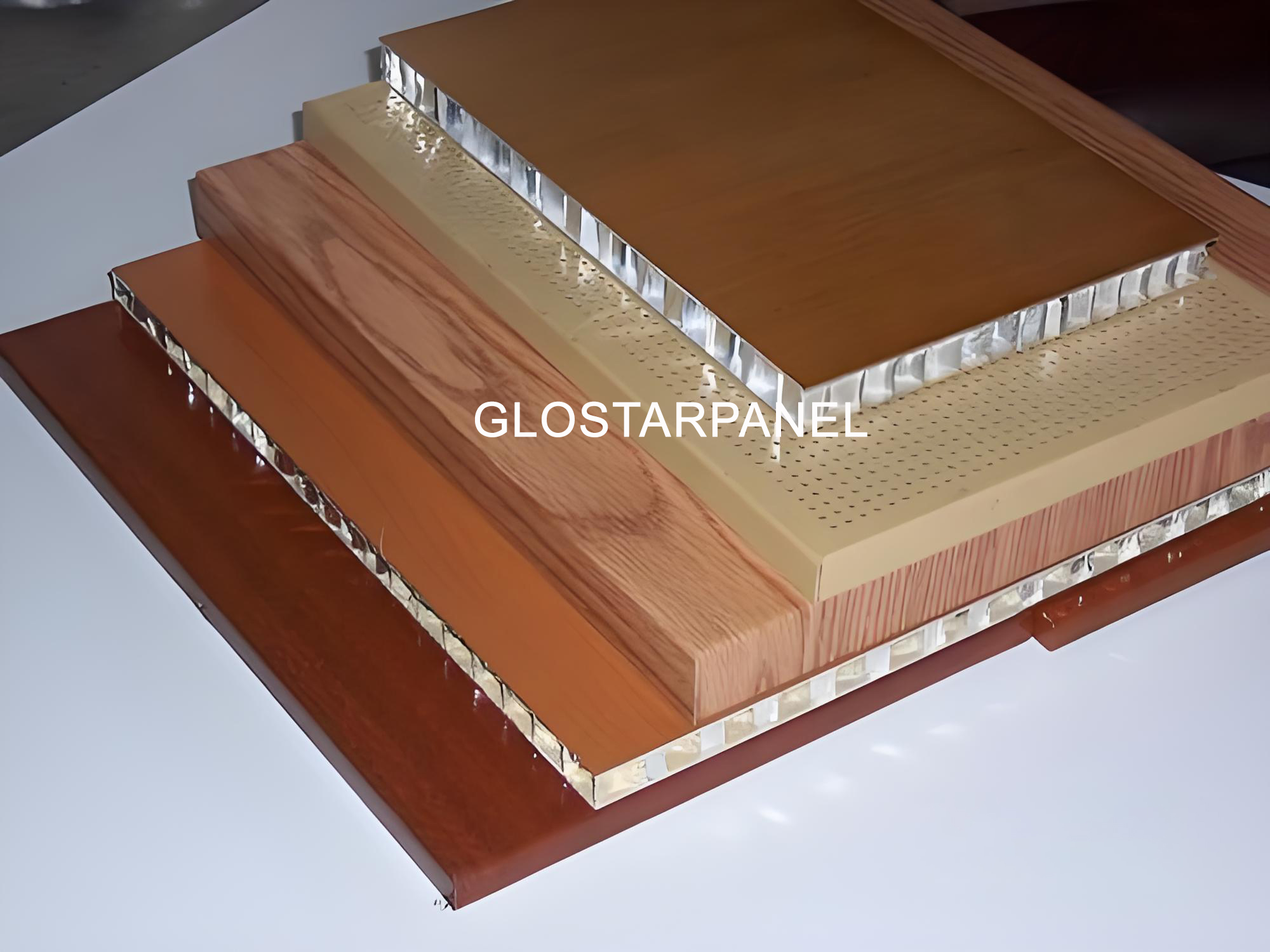
A perforated aluminum honeycomb panel does not absorb sound the way mineral wool or open-cell foam does. There is no fibrous tangle for sound to rub against, no porous skeleton to convert particle motion into heat through friction at a million tiny surfaces. The absorption comes from something closer to a musical instrument. Each hexagonal cell in the honeycomb core is a sealed air chamber, and the perforation above it is a neck. Sound pressure at the hole forces a small plug of air in and out of the cavity, and the air mass in that neck oscillates against the springiness of the air inside the cell. That is a Helmholtz resonator, repeated hundreds of times per square meter across the sheet.
The practical consequence of that mechanism is selectivity. A porous absorber is broad and forgiving, soaking up a wide band at modest efficiency. A resonator is narrow and deliberate, hitting a targeted range hard and leaving the rest largely alone. The perforated honeycomb panel sits in the second category. Get the cavity depth and hole geometry right for the noise problem at hand, and the absorption coefficient in that band can climb steeply. Get them wrong, and the panel looks acoustically inert even though the holes are visible and the core is intact.
The Cell Depth Is the Tuning Knob
The hexagonal core is not just a lightweight spacer behind the perforated skin. It is the spring in the system, and its depth sets the resonant frequency. A shallow cell, say 10 to 15 mm, puts the absorption peak higher in the spectrum, where speech consonants and high-frequency machinery whine live. A deeper cell, 50 mm or more, drags the peak down toward the lower midrange and the upper bass, where male speech fundamentals and the rumble of ventilation systems sit.
This relationship is not linear in a way that lets a designer guess. Doubling the cavity depth does not simply halve the peak frequency. The neck length, which is the thickness of the perforated skin plus any boundary layer effects at the hole, also enters the calculation. A 1 mm facing behaves differently from a 1.5 mm facing with identical hole diameter and open area. That is why acoustic test data for one panel thickness cannot be pasted onto another build without correction. The honeycomb cell size adds a second layer of behavior. Smaller cells partition the backing volume into more, smaller resonators, which changes the effective cavity stiffness and can broaden the absorption curve slightly compared with a large-cell core of the same overall depth.
Perforation Geometry Is a Trade-Off, Not a Setting
Open area is the variable most likely to be misunderstood on a submittal sheet. A higher percentage of open area lets more sound into the cavities, but it also reduces the acoustic resistance at the neck. Too little resistance and the resonator becomes underdamped, peaking sharply but over a narrow band. Too much and the panel starts behaving more like a leaky rigid sheet, with the cavity contribution fading. The usable window in commercial acoustic honeycomb panels tends to sit between roughly 15 and 30 percent open area, with hole diameters in the low single-digit millimeter range for architectural work and tighter micro-perforations for finishes where the holes should not read at normal viewing distance.
Hole pattern matters less for the peak frequency than for the uniformity of absorption across the panel face. A staggered or triangular array distributes the necks more evenly than a square grid and avoids the visual banding that appears under grazing light on large ceiling runs. The pattern also affects how the facing behaves structurally. A dense array of small holes removes less stiffness from the skin than a sparse array of large holes of the same open area, which is one reason micro-perforated facings can hold flatter over long spans.
What a Reverberation Chamber Reveals That a Single Number Hides
The standard way to characterize absorption is a reverberation room test under ASTM C423 or ISO 354, which produces absorption coefficients across one-third octave bands and rolls them into a single Noise Reduction Coefficient.That single NRC number is convenient for specifications and nearly useless for understanding whether the panel will solve a particular noise problem, because two panels with the same NRC can have completely different absorption curves.
| Panel build | Cavity depth | Open area | NRC | Weighted αw | Where the absorption actually sits |
|---|---|---|---|---|---|
| Thin perforated facing over shallow honeycomb | 10 to 15 mm | 20 to 25% | 0.55 to 0.65 | 0.45 to 0.55 | Upper midrange and high frequencies, little below 500 Hz |
| Micro-perforated skin over medium honeycomb | 25 to 50 mm | 5 to 15% | 0.75 to 0.85 | 0.65 to 0.75 | Speech range and lower midrange, usable from about 250 Hz |
| Fine micro-perforation over deep honeycomb | 100 mm and above | 2 to 10% | 0.85 to 0.90 | 0.70 to 0.80 | Extended low-mid absorption, peak can be tuned below 500 Hz |
The independent test data behind the middle rows is worth reading closely. A build using a 1 mm micro-perforated aluminum facing, a 100 mm honeycomb core, and a thin galvanized backing returned NRC 0.90 and weighted αw 0.75, Class C, under ASTM C423 and ISO 354 in an accredited laboratory.That is a strong result for a metal-faced panel, but the Class C rating is a reminder that the absorption is not flat across the frequency range. The panel earns its number in a specific band, and outside that band it behaves much like a rigid sheet.
A Meeting Room Where the Absorption Had Somewhere to Work
An instructive field case comes from a small meeting room with a volume around 91 cubic meters where the reverberation time sat above two seconds from 250 Hz through 2 kHz, which is long enough to smear speech into an unintelligible blur. The retrofit used honeycomb-backed micro-perforated absorbers mounted as additional wall and ceiling elements rather than as a full interior rebuild. The design was tuned with an electroacoustical equivalent circuit before installation, and placement was checked with a wave-based finite element simulation.
After installation, reverberation time dropped below 1.5 seconds across the measured bands. The equivalent absorption area doubled. Early decay time at 1 kHz fell from 2.7 seconds to 1.0 second, clarity in the midrange improved by more than 5 dB, and the speech transmission index moved from 0.55 to 0.67, a one-rank improvement.The panel did not make the room acoustically perfect. It made speech intelligible without forcing occupants to raise their voices, which is the realistic target for a treatment of that scope.
The Honest Limits of a Resonant Panel
A perforated honeycomb absorber is a poor choice for broadband noise control across a wide spectrum. It is also not a barrier. The perforations that admit sound into the cavities are pathways for air and water vapor, and a panel with an open facing will not provide the sound transmission loss of a sealed honeycomb sheet. Where both absorption and isolation are required, the build usually needs a separate sealed barrier layer behind the absorber, not a single panel trying to do both jobs.
Low-frequency performance below roughly 200 Hz demands cavity depths that become impractical for wall and ceiling assemblies. A resonator can be designed to peak at 125 Hz, but the depth required often exceeds what a architectural build can accommodate. In those cases the honeycomb absorber is part of a treatment package that includes separate bass absorption or modal control, not a standalone fix. The panel is best understood as a tunable midrange and low-midrange tool with a flat, rigid face, not as a universal acoustic solution.
What Manufacturing Control Can and Cannot Fix
The acoustic performance of a perforated honeycomb panel depends on three things that are set before the panel reaches a test chamber: the precision of the perforation, the consistency of the core cell geometry and depth, and the integrity of the bond between facing and core. A hole diameter that drifts across the sheet changes the open area and shifts the resistance. A core that crushes unevenly during layup changes the local cavity depth and detunes sections of the panel. These are manufacturing variables, not installation variables, and no site adjustment recovers them.
Glostar Panel’s honeycomb panel lines cover facing thicknesses in the 0.7 to 1.2 mm range and core heights that include 18.5, 23.5, and 28.5 mm as standard builds, with perforation patterns controlled at the facing stage rather than drilled after assembly.That order of operations matters for acoustic consistency, because the hole geometry stays tied to the skin that was tested rather than being modified downstream. The limitation is that a well-made panel still depends on a design that matches the cavity depth and open area to the actual noise spectrum. Manufacturing precision holds the tolerance. It does not choose the tuning.