
 EN
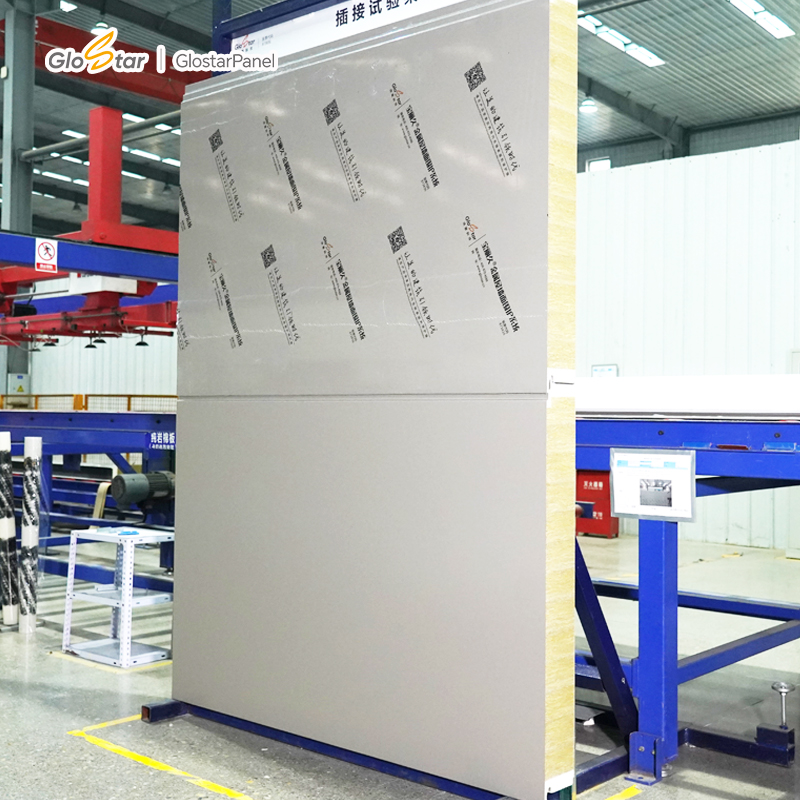
A bundle of sandwich panels that looks dead flat on the delivery truck can cup at the edges after three days on a sunny site. The facings are still intact, the core is still bonded, and nothing has been dropped. What changed is how the bundle was bedded, lifted, and left to sit. Most warping calls that reach a panel supplier are not manufacturing defects. They are logistics decisions made after the panels left the production line, and they usually cost more to fix than the panels themselves because replacement sheets are made to order while the installation crew is already standing on site.
The mechanics are simple once the layers are separated. A sandwich panel is two thin metal skins bonded to a core that is much softer in shear. The skins want to stay where they were formed. The core resists compression but not sustained point loads, and it moves with moisture and temperature at a different rate than the steel. Warping appears when one face expands or contracts more than the other, or when the core is crushed unevenly so the panel can no longer hold its original profile. Storage and transport either protect that balance or quietly break it.
The Unloading Inspection Sets the Baseline
The claim window for transit damage closes fast, and a flat-looking bundle is not proof of a flat panel inside. Before the slings come off, sheet count, thickness, cut length, and bundle labels need to match the delivery note. Edge damage is the most common unloading defect because the tongue-and-groove joint sits right at the perimeter where forklift tines and crane straps make contact. A crushed joint edge will not disappear during installation, and it often pulls the first meter of the panel out of line.
Water marks inside the wrapping deserve the same attention as dents. If the bottom sheet shows condensation staining or white rust between the skins, moisture has already entered the pack. That moisture does not always cause visible swelling immediately. It can sit in the core and create a differential later, especially when one face is exposed to sun on site while the other remains shaded. Photographs with a date, taken before the delivery note is signed, are the difference between a supplier claim and a contractor absorbing the cost.
Lifting Without Bending the Panel
A sandwich panel tolerates a lot of load when it is supported along its length and very little when it is picked from a single point. The pickup pattern matters more than the lifting equipment brand. For bundles up to six meters, a forklift with forks spread to full separation and the load centered is the normal approach. Beyond six meters, crane lifting with nylon web slings at least 200 mm wide becomes the safer choice, with timber battens between each sling and the bundle so the strap does not bite into the facing.
Steel cable should never replace synthetic slings on coated panels. The cable concentrates force on a narrow line and leaves a crimp that is visible after installation and impossible to flatten out. For bundles over ten meters, a spreader bar keeps the slings apart and the pick points sit at roughly three fifths of the bundle length so the panel does not sag between them. Vacuum lifters are useful for single panels on the wall, but they need a clean, flat facing to seal, and the protective film has to be peeled back where the suction cup lands. A vacuum cup on a dusty or film-covered surface is a slow leak waiting to drop a sheet.
Stack Geometry and Support Spacing
Flat storage is not the same as supported storage. A bundle laid on two bearers near the ends will bridge over the middle, and the bottom panel will creep under its own weight plus the weight above it. Over time that creep becomes a permanent bow. The support spacing should keep the unsupported span short enough that the panel cannot sag between bearers, and the bearers themselves need to be level with each other so the load is shared evenly rather than concentrated on one high point.
The table below compares common field practices against the engineering standard they are trying to meet. The numbers are pulled from European handling guidance and product standard EN 14509, which is the reference most panel manufacturers and specifiers work from in export markets.
| Jobsite operation | Common field shortcut | Engineered standard |
|---|---|---|
| Ground bedding | Bundle flat on dirt or sealed plastic | Timber bearers at 1.0 to 1.5 m centers, ventilated gap under the pack |
| Drainage | Wrapped tight, ends closed | 5% longitudinal slope, end tarpaulins left open for air movement |
| Stack height | Three or more bundles with no spacers | Maximum three bundles, timber or polymer spacers between every tier, base capacity checked first |
| Lifting gear | Steel wire choker or single-point pick | Wide synthetic slings with edge battens, spreader bar beyond 10 m |
| Protective film | Left on until project handover | Peeled within 15 days of fixing, never left in direct sun beyond 30 days |
The stack height number is not a suggestion. A bundle at the bottom of a three-high stack carries the weight of two packs above it, and if the bearers are not aligned from tier to tier the load path runs diagonally through the panels instead of straight down. That diagonal load is what crushes the core at the support line and leaves a wave in the facing that shows up under low-angle sunlight after the wall is closed.
Moisture and Thermal Gradients Do the Slow Damage
Two faces of a sandwich panel can easily see a 30 to 40 degree difference in surface temperature on a sunny day, and EN 14509 uses design surface temperatures of 55 degrees Celsius for very light colors, 65 degrees for light colors, and 80 degrees for dark colors to account for that spread. The face in sun wants to expand. The shaded face does not. The core restrains both, but if the panel is fixed rigidly at that moment the differential has nowhere to go except into bowing. This is thermal bowing, and it is not the same as a manufacturing camber. It shows up as a smooth curve over the panel length, often most visible on dark roof panels in the late afternoon.
Moisture works on a slower clock but can be more permanent. Some foam cores absorb moisture in warm, humid conditions and shrink irreversibly as they dry, which pulls the facings out of plane and leaves a warp that does not relax. Mineral wool cores handle water differently but still lose stiffness when saturated, and a wet pack stored under a sealed cover in the sun becomes a small greenhouse. The practical response is not to hermetically seal the bundle but to let air move through the stack while keeping rain off the top and the ground away from the bottom. Sloped dunnage with open ends does more for a stored pack than a tight tarp pulled over a flat stack.
A Site Case Where the Bearers Were the Problem
A retrofit project on an industrial building envelope a few years back ran into a batch of rock wool panels that would not sit flush against the purlins. The panels had been delivered flat, stored on site for two weeks, and looked fine when the wrapping came off. Once laid on the roof, the ends lifted by 15 to 20 mm on a three-meter straightedge. The suspicion landed on the factory first, but the delivery photos showed the bundles resting on three timber bearers spaced about 1.8 meters apart, with a fourth bearer only under one end. The pack had also been stacked two high on soft ground after rain, so the bottom bundle was bridging between the outer supports while the ground settled under the middle.
The core at the support lines was visibly compressed, and the facings had taken a set. No amount of clamping during installation brought the panel back. The fix was a full replacement of the bottom bundle, plus a site instruction to set bearers at one-meter centers on a rolled and compacted gravel pad, with a 5% slope and the ends of the wrap opened. The factory batch tested within flatness tolerance. The warp was created in the laydown area, not in the production hall.
What Can Be Controlled Before the Panel Leaves the Line
Some of the warping risk is locked in before the bundle ever reaches a truck. Face flatness, core density uniformity, and moisture content at the time of foaming or bonding determine how much movement the finished panel can absorb later. A panel that starts with a consistent skin tension and a core that is fully cured has more reserve against a week of imperfect site storage than a panel that left the line with residual stress in the facings. This is where Glostar Panel’s manufacturing setup matters in a practical sense: the multi-line operation and the flat-press control on PU and PIR panels are aimed at holding skin tension and thickness consistency across the sheet, so the panel has less built-in tendency to cup when the support conditions on site are less than perfect.
The honest limitation is that no factory control can compensate for a bundle left flat on wet ground with the film baking in the sun. Storage discipline still decides the outcome. But when the panel starts flat and the site crew follows the spacing and lifting rules, warping complaints drop to the occasional transit edge dent rather than a batch-level rejection. That is a much cheaper problem to solve.