
 EN
EN
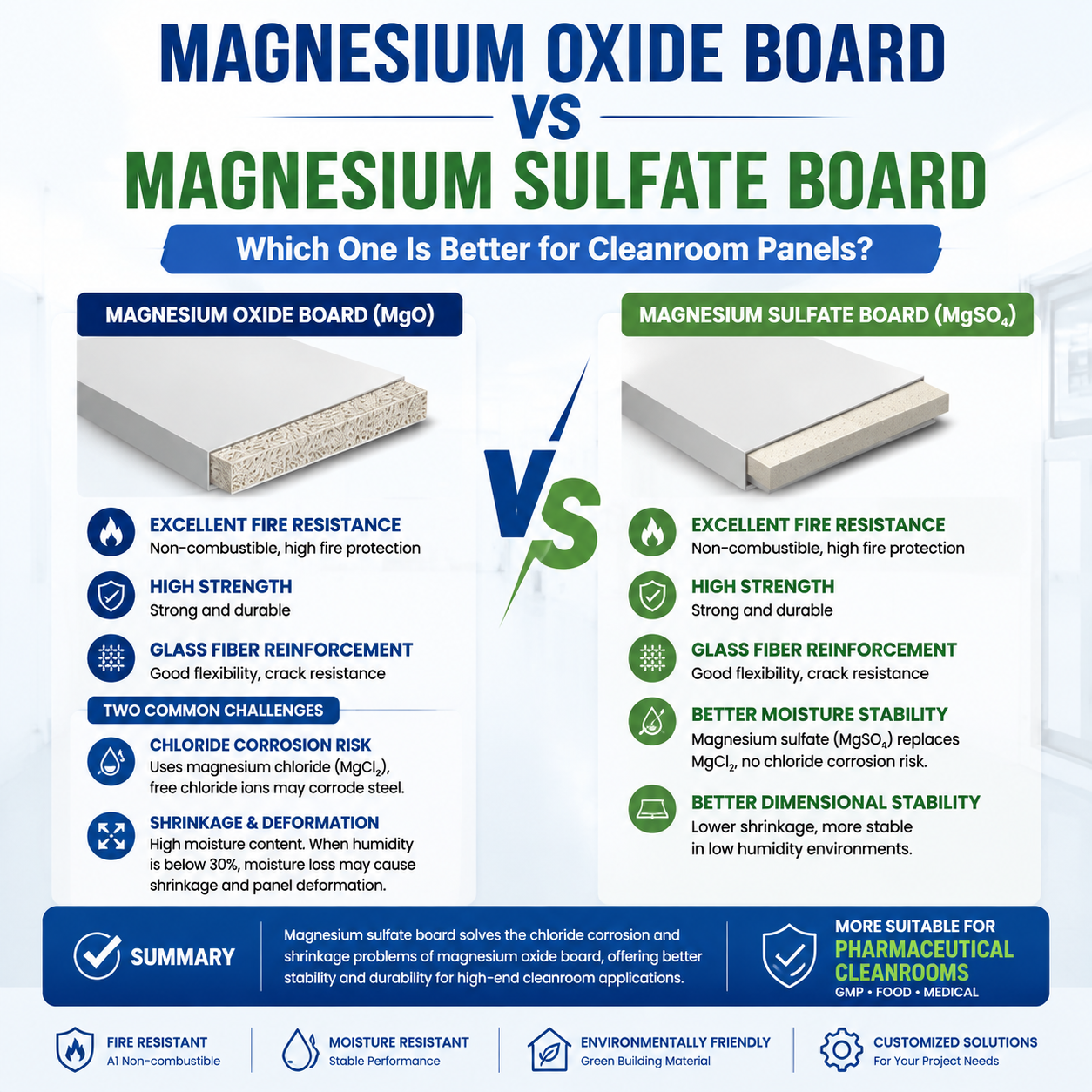
When selecting cleanroom sandwich panels, the core material plays an important role in fire resistance, structural performance, durability, and long-term stability.
Among different fire-resistant core materials, magnesium oxide board (MgO board) and magnesium sulfate board (MgSO₄ board) are widely used for their excellent fire resistance and high strength.
Although their prices are relatively close, there are significant differences in material composition and long-term performance.
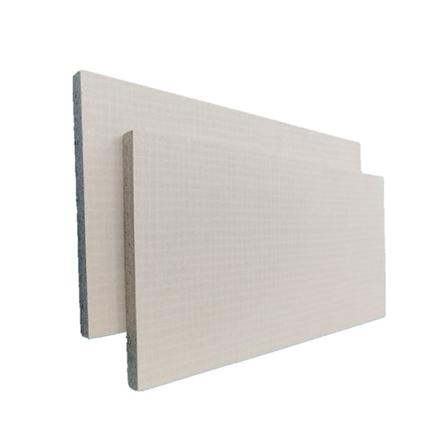
1. Magnesium Oxide Board: Features and Challenges
What Is Magnesium Oxide Board?
Magnesium oxide board is a fire-resistant building material made mainly from:
- Magnesium oxide (MgO)
- Magnesium chloride (MgCl₂)
- Magnesium sulfate
- Glass fiber mesh reinforcement
- Other additives
The addition of glass fiber mesh improves the flexibility and impact resistance of the board, making it suitable for applications such as:
- Cleanroom wall panels
- Fire partitions
- Industrial buildings
- Prefabricated structures
Advantages of Magnesium Oxide Board
1. Excellent Fire Resistance
MgO board has excellent fire performance and can meet high fire protection requirements for industrial and cleanroom applications.
2. Good Mechanical Strength
The internal glass fiber mesh improves:
- Tensile strength
- Crack resistance
- Structural stability
2. Two Common Problems of Magnesium Oxide Board
Although MgO board has many advantages, traditional magnesium oxide materials also have two major challenges:
Problem 1: Moisture Absorption and Chloride Corrosion
Traditional MgO boards use magnesium chloride (MgCl₂) as one of the main components.
Under humid conditions, free chloride ions may migrate from the core material.
This can cause:
- Steel sheet corrosion
- Surface defects
- Reduced service life of sandwich panels
This problem is commonly known as "magnesium chloride moisture return" (halogen return phenomenon).
Problem 2: Shrinkage and Panel Deformation
Magnesium oxide core materials usually contain a relatively high amount of moisture after production.
When the environmental humidity decreases significantly, especially below approximately 30%, moisture inside the material gradually evaporates.
During this process:
- The core material shrinks
- Internal stress increases
- Steel sheet deformation may occur
- Panel flatness may be affected
For cleanroom applications requiring high dimensional stability, material shrinkage control is especially important.
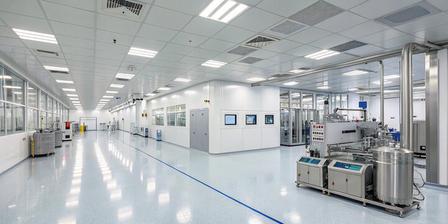
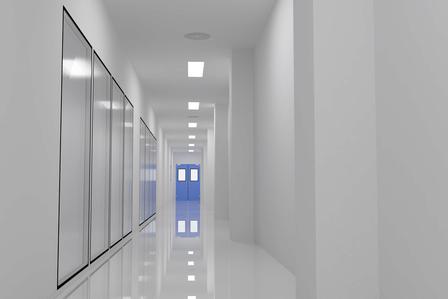
5. Which One Should You Choose for Cleanroom Panels?
The choice depends on the project requirements.
Choose Magnesium Oxide Board When:
✔ Budget control is important
✔ General industrial buildings
✔ Standard fire protection requirements
✔ Normal indoor environment
Choose Magnesium Sulfate Board When:
✔ Pharmaceutical cleanrooms
✔ Food processing facilities
✔ High humidity environments
✔ Projects requiring long-term stability
✔ Strict cleanliness and durability requirements
Conclusion
Both magnesium oxide board and magnesium sulfate board provide excellent fire resistance and structural performance for sandwich panels.
However, for high-end applications such as GMP pharmaceutical cleanrooms, medical facilities, and precision manufacturing environments, magnesium sulfate board provides better moisture resistance and dimensional stability due to its improved material composition.
Selecting the right core material is essential for ensuring the long-term performance of cleanroom sandwich panels.
Table of Contents
- 1. Magnesium Oxide Board: Features and Challenges
- What Is Magnesium Oxide Board?
- Advantages of Magnesium Oxide Board
- 2. Two Common Problems of Magnesium Oxide Board
- Problem 1: Moisture Absorption and Chloride Corrosion
- Problem 2: Shrinkage and Panel Deformation
- 5. Which One Should You Choose for Cleanroom Panels?
- Choose Magnesium Oxide Board When:
- Choose Magnesium Sulfate Board When:
- Conclusion