
 EN
EN
The Structural Puzzle That Honeycomb Solves
In structural engineering, there's a persistent tension between two competing demands: make it strong enough to handle the loads, and make it light enough to handle practically. For decades, designers have chased materials that deliver high stiffness without the weight penalty. Aluminum honeycomb panels represent one of the more elegant solutions to this problem—not through exotic materials or complex manufacturing, but through a geometry that's been optimized by nature for millions of years.
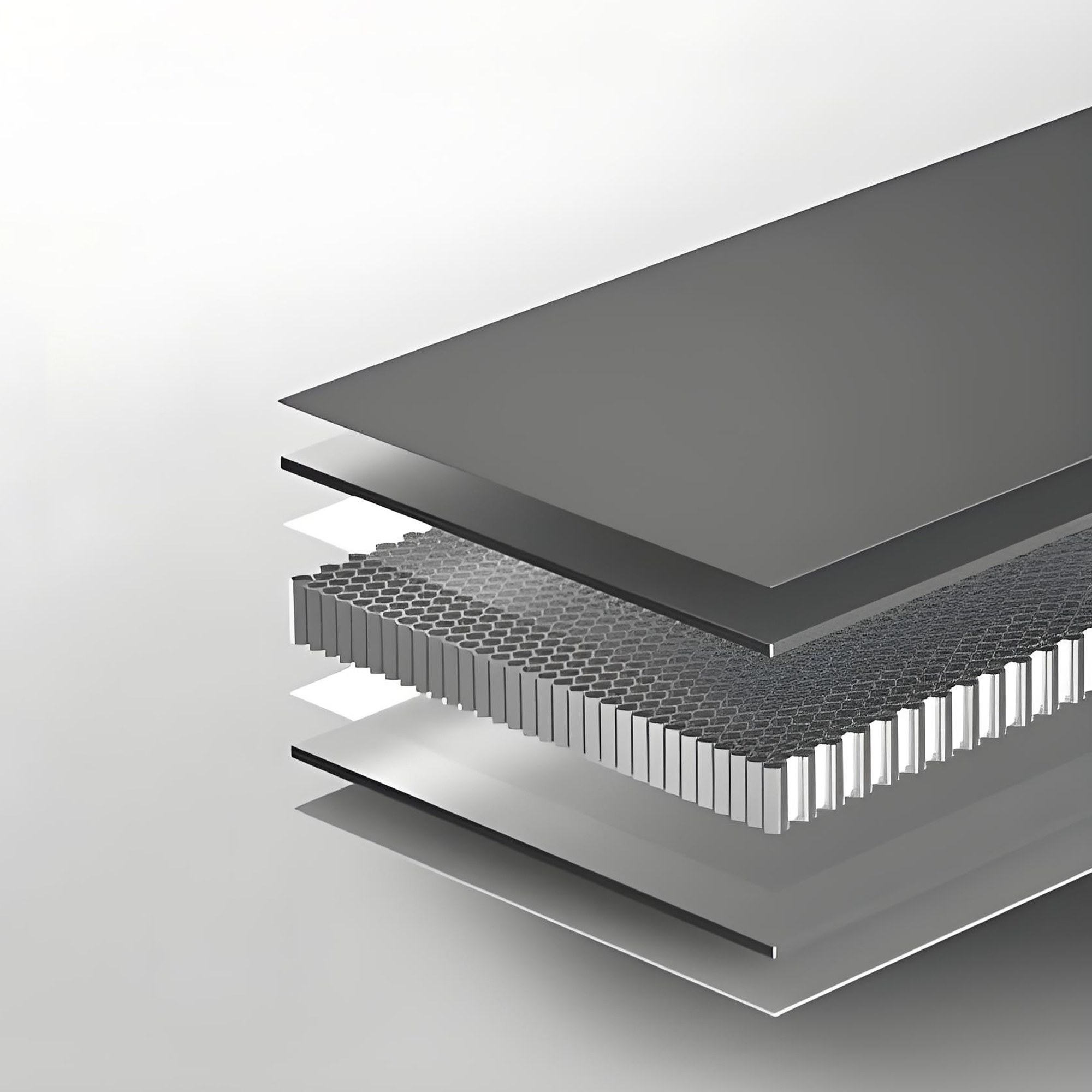
The honeycomb structure isn't a gimmick. Each hexagonal cell functions like the web of an I-beam, providing out-of-plane compression resistance and shear stiffness while keeping the overall density remarkably low. The result is a sandwich panel that delivers stiffness characteristics far beyond what the base aluminum alloy alone could achieve.
The Geometry Behind the Numbers
The stiffness-to-weight ratio of a honeycomb panel comes from the way the structure distributes load across the entire panel section. Two thin aluminum face sheets carry the bending and in-plane loads, while the honeycomb core maintains the distance between them and resists shear deformation. This sandwich construction means the panel behaves like a much thicker solid section—without the weight.
The mechanical properties tell the story. For the aluminum honeycomb core itself, the tensile modulus sits around 70.6 GPa, with a bulk modulus of 75.2 GPa. But these numbers only capture part of the performance. When the core is bonded to face sheets, the composite panel achieves stiffness levels that can reach more than 30 times higher than a solid aluminum sheet of the same weight, with flexural strength up to 10 times greater.
| Property | Solid Aluminum Sheet | Aluminum Honeycomb Panel (Same Weight) |
|---|---|---|
| Relative stiffness | 1× | 30× |
| Relative flexural strength | 1× | 10× |
| Density | 2.7 g/cm³ | Core as low as 0.083 g/cm³ |
How the Honeycomb Core Actually Works
Each cell in a honeycomb core acts as a small column resisting compression between the face sheets. When a load is applied to the panel surface, the face sheets bend slightly, and the core transfers shear forces between them. The hexagonal geometry is particularly efficient because it provides uniform properties in multiple directions—the cells don't have a preferred orientation that creates weak spots.
The core also handles energy absorption remarkably well. Experimental testing comparing aluminum honeycomb with closed-cell aluminum foam showed that the honeycomb structure consistently absorbed more specific energy under compressive loading. This energy absorption capability matters in applications where impact resistance is a concern, though the primary benefit for most building applications remains the stiffness-to-weight advantage.
A Real-World Installation That Put It to the Test
During the renovation of a large logistics center in the southeastern United States, the design team needed to replace aging overhead panels in a mezzanine area. The original solid aluminum panels were heavy enough to require structural reinforcement of the supporting framework—a costly proposition. Aluminum honeycomb panels were specified as the replacement, with a core thickness selected to match the stiffness requirements of the original design.
The installation team reported that the new panels weighed roughly one-fifth of the originals while providing comparable stiffness. The reduction in dead load meant the existing support structure didn't need reinforcement, saving both material costs and construction time. More importantly, the panels maintained their flatness across the full span without sagging—a common failure mode for lighter gauge solid panels under similar loading.
Beyond Aerospace—Where This Matters in Building Construction
Aluminum honeycomb panels have deep roots in the aerospace industry, where every gram of weight reduction translates directly to fuel savings or payload capacity. Aircraft interiors, wing components, and spacecraft structures all use honeycomb construction for its unmatched efficiency. But the same principles apply to building construction, particularly in applications where dead load reduction offers structural or logistical advantages.
In curtain wall systems, the weight reduction means lighter supporting structures and smaller foundations. In elevated floors and access platforms, it means easier handling during installation and less stress on supporting beams. And in applications where panels must be lifted into place by crane or installed at height, the weight difference between a honeycomb panel and a solid alternative can be the difference between a straightforward installation and a complex rigging operation.
The Limitations Worth Acknowledging
No material is perfect, and aluminum honeycomb panels have their constraints. The core is vulnerable to crushing at localized points—a screw over-tightened or a sharp impact can permanently deform the core beneath the face sheet. Moisture ingress into the core can also be problematic, as trapped water adds weight and can accelerate corrosion at the bond lines between core and skins.
The panels also cost more than traditional solid sheet alternatives, both in materials and fabrication. The bonding process between core and face sheets requires precise control, and the expansion or corrugation processes used to manufacture the core add manufacturing complexity. For applications where weight reduction isn't a priority, simpler solutions may be more cost-effective.
Where Aluminum Honeycomb Panels Make the Most Sense
The decision to use aluminum honeycomb panels comes down to whether the stiffness-to-weight advantage justifies the additional cost. In applications where:
Dead load reduction allows lighter support structures
Handling and installation logistics favor lighter panels
Flatness under load is critical for the application
The service environment is dry and corrosion risks are manageable
For building systems where lightweight rigidity is a design priority, Shandong Glostar Panel Building Systems offers aluminum honeycomb panel solutions that balance performance with practical manufacturing considerations. Their production capabilities ensure consistent core bonding and face sheet adhesion, delivering the stiffness-to-weight performance that architects and engineers specify.
Table of Contents
- The Structural Puzzle That Honeycomb Solves
- The Geometry Behind the Numbers
- How the Honeycomb Core Actually Works
- A Real-World Installation That Put It to the Test
- Beyond Aerospace—Where This Matters in Building Construction
- The Limitations Worth Acknowledging
- Where Aluminum Honeycomb Panels Make the Most Sense